
A few weeks ago, I went to Bamboo Sushi with a few friends.
The dining room was fairly packed, so we waited for a table. While we stood near the entrance, a delivery driver walked past us, gave a name, picked up a bag, and left.
Then another did the same thing.
Then another.
Then another.
Four delivery orders left the restaurant before we were even seated.
Once we finally got a table, the same thing kept happening in the background. Our food wasn’t arriving quickly enough to ignore it, either. At some point, we started talking about what had become strangely obvious from the dining room: the kitchen wasn’t just feeding the people sitting inside the restaurant.
It was feeding another restaurant’s worth of customers we couldn’t see.
That experience stuck with me because third-party delivery is usually discussed as a simple tradeoff. DoorDash, Uber Eats and Grubhub bring restaurants more orders, and in exchange restaurants pay a commission.
But that framing skips two much more important questions:
Did the delivery app actually create the order?
And if it did, was the order profitable enough to justify the cost and kitchen capacity required to fulfill it?
Those questions matter because marketplace delivery can carry fees ranging from roughly 15% to more than 30% of the food sale. Paying that kind of acquisition cost makes much more sense when an app introduces a new customer to your restaurant.
It looks very different when the customer already wanted your food.
Imagine three people placing the exact same $50 delivery order.
One opens DoorDash, searches for sushi, discovers your restaurant and orders for the first time.
Another already knows your restaurant, but opens Uber Eats because that is simply how they order dinner. The app reminds them about you and helps close the sale.
The third Googles your restaurant by name, already knows exactly what they want, and ultimately places the order through a marketplace listing.
From the restaurant’s perspective, all three may appear as marketplace sales.
Economically, they are not the same customer.
That distinction is where delivery-app economics really begins.
Not Every Delivery-App Order Is a New Customer
The difficult part is that restaurants rarely know precisely how much of their marketplace volume falls into each bucket.
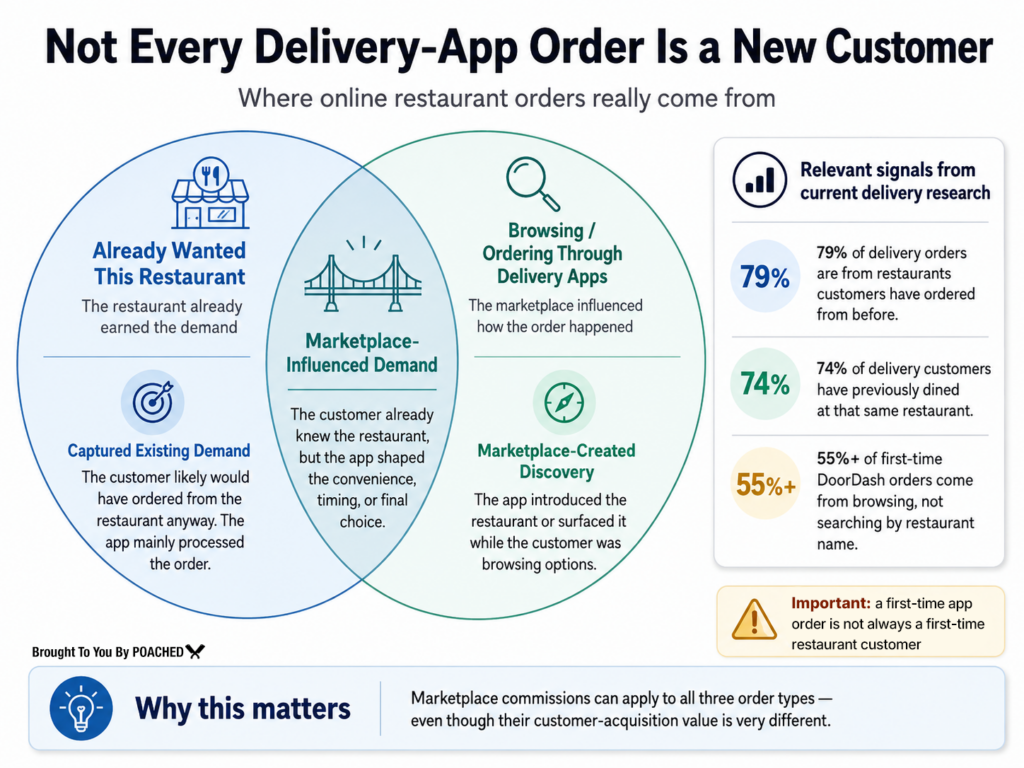
Some orders are genuine discovery: business the restaurant may never have received without the marketplace.
Some are influenced by the app’s convenience, recommendations or habit.
And some portion is existing demand that crossed through the marketplace on its way to a restaurant the customer had already chosen.
The commission can apply to all three.
The value of that commission does not.
How Much Does a $50 Order Really Cost a Restaurant?
The second mistake restaurants make after treating every app order like a new customer is treating every delivery fee like the same fee.
They are not.
A direct digital order and a marketplace order may both end with a bag of food and a delivery driver at the door, but the economics are completely different. In a direct order, the restaurant already has the customer. The platform is mostly providing convenience, payment processing, and in some cases delivery fulfillment. In a marketplace order, the platform is charging the restaurant for discovery, customer acquisition, and transaction processing all at once.
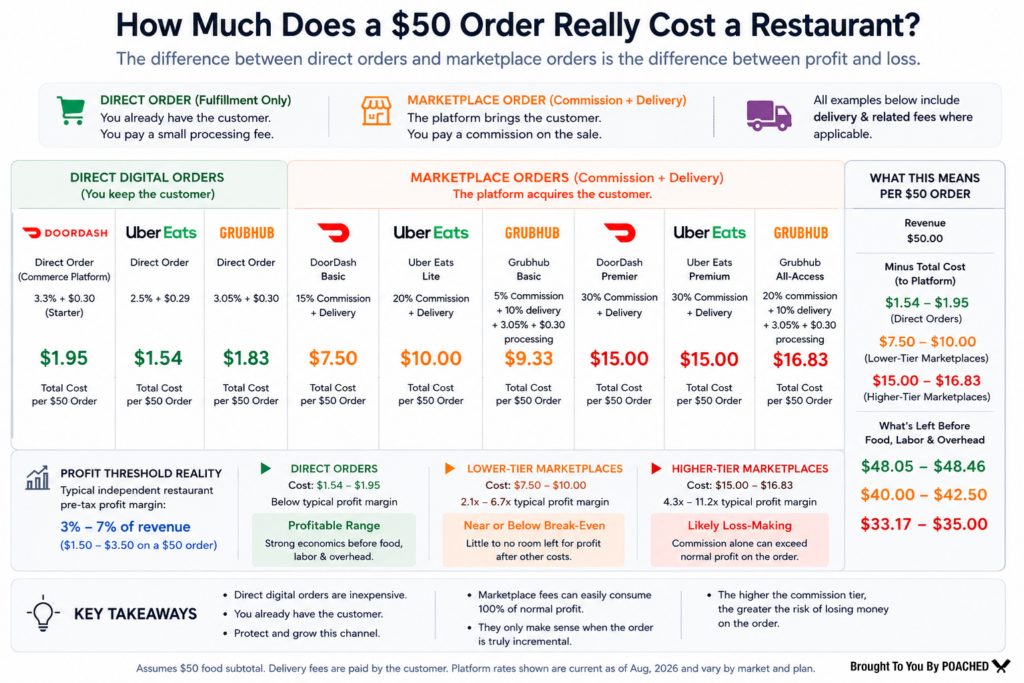
That is why a direct $50 order can cost the restaurant less than $2 in platform fees, while a marketplace order on the same $50 subtotal can cost anywhere from roughly $7.50 to more than $16 before food, labor, packaging, and overhead are even considered.
This is also where the pricing gets confusing for operators. Some app costs are either/or, while others are cumulative.
A marketplace commission is generally an either/or structure. A restaurant is not paying DoorDash’s 15% Basic rate and 30% Premier rate on the same order. It is on one plan or another. The same is true for Uber Eats’ Lite, Plus, and Premium tiers, or Grubhub’s different marketplace packages.
But within a single order, some costs can stack. Grubhub is the clearest example: marketing commission, delivery fulfillment, and payment processing can all be separate line items. That means the advertised headline rate does not always equal the full platform cost. This is one reason the phrase “delivery apps take 30%” is too simplistic to be literally correct in every case.
Still, it is directionally meaningful.
At the high end, many marketplace orders really do approach that territory once the full cost structure is accounted for. And even lower-tier marketplace orders can consume an amount of money that is several times larger than the normal profit margin on a typical restaurant sale.
That distinction matters because a delivery platform is not always doing the same job.
Sometimes it is simply fulfilling an order the restaurant already earned. The customer searched for Bamboo Sushi by name, clicked “order online,” and used a DoorDash-powered checkout on Bamboo’s own site or Google profile. In that case, the platform is mostly acting as the infrastructure behind a direct sale.
Other times, the platform is acting as a true marketplace. The customer opens DoorDash or Uber Eats without a restaurant in mind, searches for sushi, sees Bamboo, and places an order. In that case, the commission is much easier to understand as an acquisition cost.
And then there is the gray area in between, which may be the most important category of all: the app can capture demand the restaurant already created and relabel it as platform-driven business.
A customer may already know Bamboo, prefer Bamboo, and fully intend to order Bamboo — but because they default to opening Uber Eats or DoorDash, that existing customer shows up economically as a marketplace transaction. The restaurant pays an acquisition-like commission on a customer relationship it may have already earned.
That is why “you keep the customer” is an important phrase, but not a perfect one. Direct ordering is the clearest way to preserve the customer relationship and avoid heavy marketplace fees, but consumer behavior does not always cooperate. Delivery apps can become the habitual ordering layer between restaurants and their own customers. In that sense, some marketplace orders are not introducing a new customer at all. They are simply intercepting an existing one.
That is also why the platform-cost graphic matters. It is not merely showing which app is cheapest. It is showing that the restaurant must first understand what kind of order it is paying for.
A $10 marketplace cost might be perfectly rational if the platform truly generated a new sale the restaurant would not otherwise have won.
That same $10 cost looks very different if the customer was already on the way.
A $50 Order Doesn’t Leave Much Room
The easiest mistake to make in restaurant math is to confuse what is left after food and labor with actual profit.
It is true that a $50 plate of food may leave something like $16 or $17 after the ingredients and wages directly tied to producing it are accounted for. But that number is not profit. It still has to help pay for rent, utilities, insurance, software, cleaning supplies, repairs, card processing, management salaries, and the other operating costs that keep the restaurant open in the first place.
That is why normal restaurant margins are so much thinner than they appear at first glance. A restaurant might sell a $50 order and ultimately keep only a few dollars of true pre-tax profit after all expenses are paid. In many cases, that may be closer to $2.50 than $16.
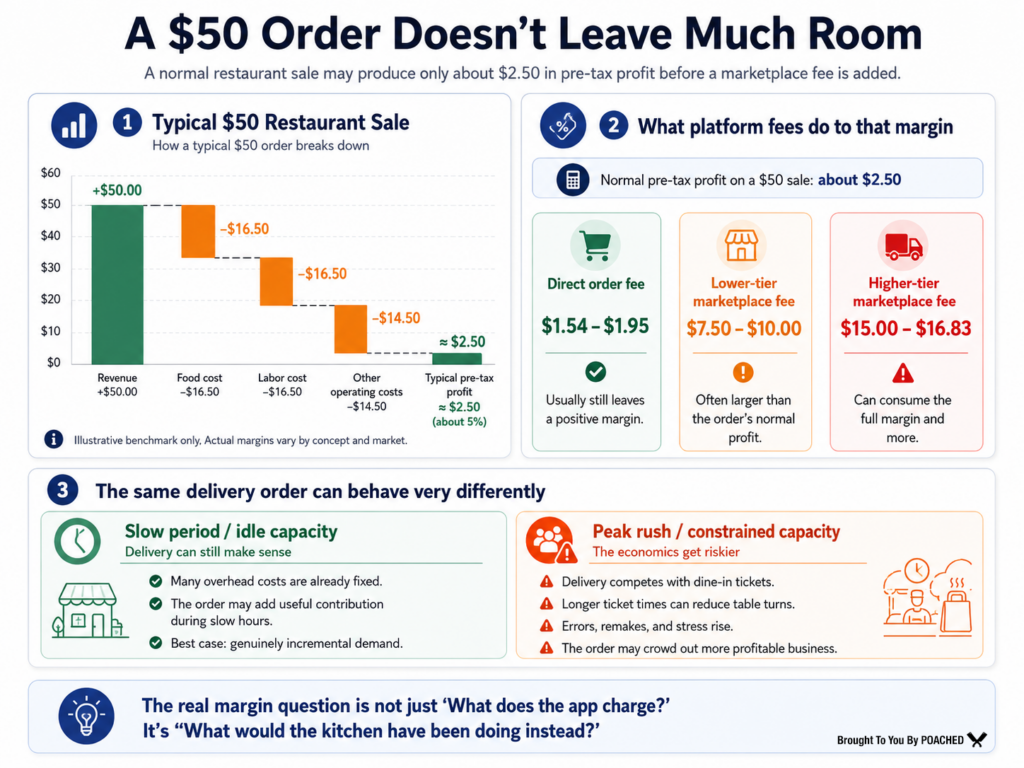
That distinction matters because marketplace fees are often large enough to consume the entire normal margin on an order.
A direct digital order may cost the restaurant less than $2 in platform fees. That still leaves room for the restaurant to earn a positive margin on the sale. But a marketplace order that costs $7.50, $10, or even $15-plus is no longer a small transactional expense. It can easily exceed the total profit the restaurant would normally expect to make on that order.
That does not automatically mean every marketplace order is a bad order.
It simply means restaurants need to think about delivery in two different ways: full-margin thinking and contribution-margin thinking.
Full-margin thinking asks a simple question:
If we allocate all of our normal business costs across this order, did it actually make money?
That is the right question when evaluating the business as a whole. If too many orders come through channels that consume the restaurant’s entire margin, the restaurant may stay busy without becoming meaningfully more profitable.
But contribution-margin thinking asks a different question:
Once the food is paid for and the order is covered operationally, does this sale still contribute something useful toward the fixed costs we are already carrying?
That question is often what makes delivery appealing in the first place.
At 3 p.m., the answer may be yes.
The staff is already on the clock. The rent is already paid. The lights are already on. The kitchen has unused capacity. In that situation, a delivery order may still make sense even if the restaurant would never want its entire business to run on those economics. The order can add useful contribution during slower hours, especially if it represents genuinely incremental demand the restaurant would not otherwise have won.
At 7:30 p.m., the answer may be very different.
Now the dining room is full. Ticket times are stretching. The kitchen is operating at or near capacity. Another delivery order is no longer simply filling idle time. It is competing for attention, labor, and production space with dine-in customers who may be more profitable and more valuable in other ways as well. If that extra delivery order slows the line, delays entrees, reduces table turns, increases mistakes, or crowds out higher-margin business, its true cost becomes much larger than the commission shown on the app statement.
That is the real margin reality check.
The question is not just whether a marketplace order produces revenue. It is whether it produces the right kind of revenue at the right time.
During slow periods, third-party delivery can help monetize unused kitchen capacity.
During peak periods, the same order can become much riskier because it is no longer adding business around the edges. It is competing with the core business itself.
That is why delivery-app economics cannot be reduced to a single number.
The same $50 order can be helpful, neutral, or actively destructive depending on what the kitchen would have been doing instead.
Should This Delivery-App Order Make Sense for Your Restaurant?
By this point, the problem with asking whether delivery apps are “worth it” should be pretty clear.
There isn’t one delivery margin.
There isn’t one kind of delivery customer.
And there isn’t one point during the week when an additional order has the same value as every other point.
A better way to evaluate delivery is to ask three questions.
Where did the customer come from?
At one end of the spectrum is genuine marketplace discovery: someone wanted sushi, opened an app, found your restaurant, and placed an order you may never have received otherwise.
At the other end is captured demand: a customer already knew your restaurant, already wanted your food, and simply routed the purchase through a marketplace.
Between those two is a large gray area of app-influenced demand—the customer already knew you, but the convenience, recommendation, promotion, or habit of using the app helped determine where and how they ordered.
The more genuinely incremental the customer is, the easier it becomes to justify paying an acquisition cost.
Does the order actually contribute financially?
This requires looking beyond sales.
Subtract the food, packaging, incremental labor, platform fees, promotions, refunds, remakes, and other costs associated with producing the order. What remains does not necessarily need to match the margin of your best dine-in transaction to be worthwhile—but it should contribute something meaningful to the business.
An order can generate revenue while contributing very little profit.
Enough orders like that can create an extraordinarily busy restaurant that isn’t actually becoming a healthier business.
And finally: does the kitchen have room for it right now?
This may be the variable restaurants overlook most often.
An incremental delivery order with a positive contribution margin at 3 p.m. can be terrific business.
The exact same order at 7:30 on Friday night may compete with guests already sitting in the dining room, extend ticket times, create mistakes, slow table turns, and put additional pressure on a kitchen that has nothing left to give.
So the final question is not merely whether you should offer delivery.
It is which delivery business you should accept, and when.
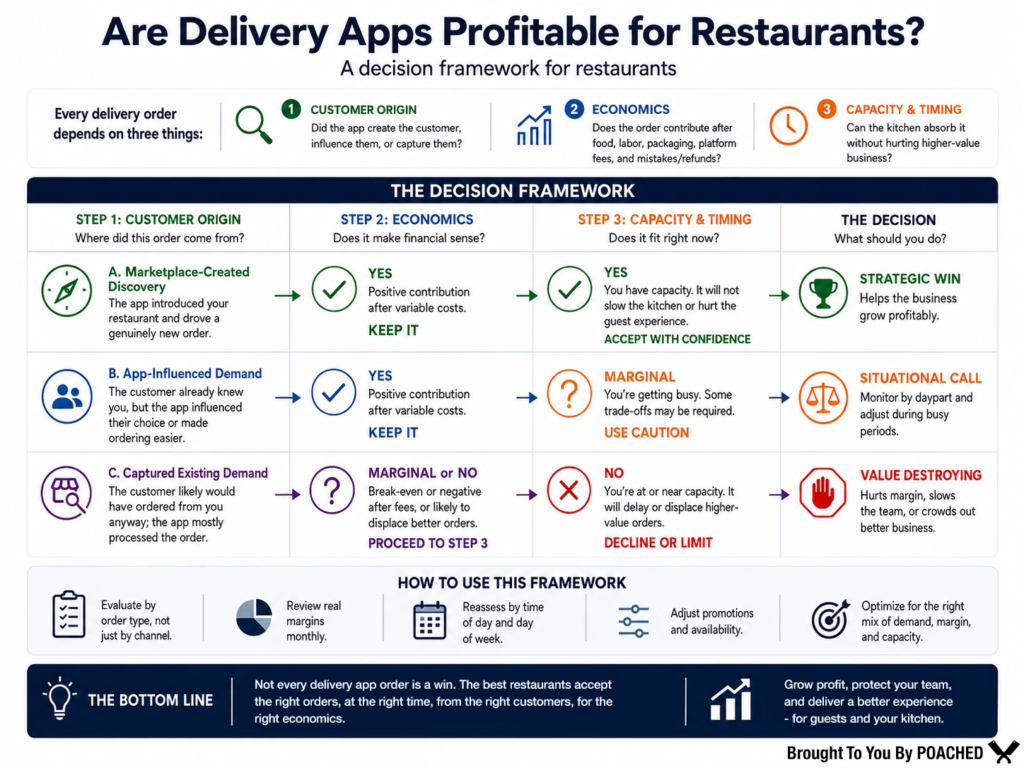
The goal of this framework isn’t to label DoorDash, Uber Eats, or Grubhub as inherently good or bad. All three can create valuable business. They can introduce restaurants to customers who might never have found them, produce additional orders during slow periods, and give existing customers a convenient way to purchase.
The problem begins when very different orders are treated as though they have identical value.
A marketplace-created customer during an otherwise quiet afternoon may easily justify the commission.
An existing customer paying through a marketplace during a completely full dinner service deserves much more scrutiny.
Most restaurants probably won’t be able to identify the exact origin and opportunity cost of every individual order as it arrives. They don’t need to.
The framework becomes useful when applied to patterns.
Look at delivery by day of the week and time of day. Compare marketplace volume with kitchen ticket times. Calculate the actual contribution after app fees and packaging. Pay attention to whether delivery spikes occur when the restaurant has excess capacity or when the kitchen is already underwater. And wherever possible, give customers who already know and seek out the restaurant an easy path to order directly.
The objective shouldn’t necessarily be to maximize delivery sales.
It should be to maximize valuable delivery sales.
That may mean using marketplaces aggressively to acquire customers and fill slow periods, building stronger direct-order channels for customers you’ve already earned, and limiting marketplace volume when additional tickets begin harming more profitable business.
Once you look at delivery this way, the decision becomes much less about whether a 15%, 25%, or 30% commission is “too expensive.”
The real question is whether this customer, at this margin, at this moment is worth buying.