
Restaurants are supposed to have some noise.
A completely silent dining room can feel just as uncomfortable as a deafening one. Conversations, music, glasses hitting the bar, an open kitchen and a full room are all part of what makes a restaurant feel alive.
But somewhere between “this place has energy” and “I can’t hear the person sitting across from me,” the noise stops contributing to the experience and starts working against it.
The interesting question isn’t simply whether your restaurant is loud.
How loud is too loud?
And unlike a lot of subjective questions about atmosphere, this one is surprisingly measurable.
Diners Can Be Bothered by Noise Earlier Than You Might Think
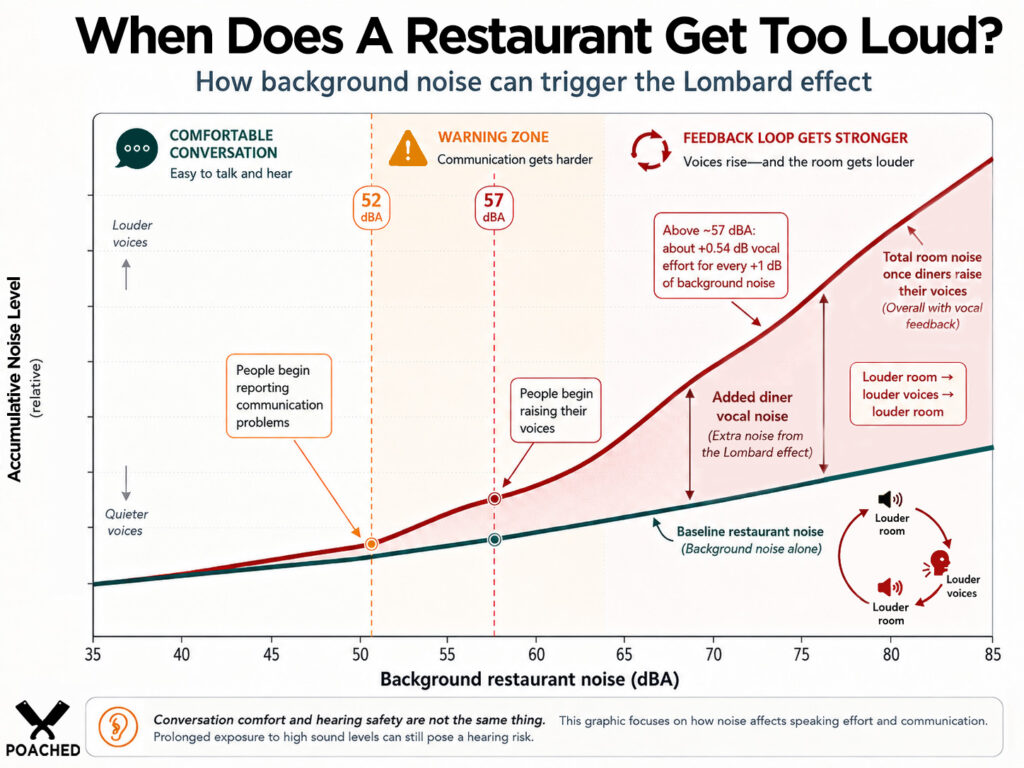
A 2018 study published in The Journal of the Acoustical Society of America exposed participants to simulated restaurant noise ranging from 35 to 85 dBA.
Researchers found two especially interesting thresholds.
At around 52 dBA, participants began reporting that the noise was disturbing their ability to communicate. Their willingness to spend both time and money in the restaurant also began declining.
At around 57 dBA, participants began increasing their vocal effort to compensate for the noise.
That five-decibel gap is worth paying attention to.
Customers may already be having a worse experience before they’re obviously shouting over your dining room.
And real restaurants can get considerably louder than that. One study measuring ten occupied eating establishments found sound levels ranging from 45 to 82 dBA.
Comfortable for conversation isn’t the same as safe for your hearing
This distinction can get confusing because you’ll often see 85 dBA quoted as an important noise threshold.
NIOSH recommends limiting occupational exposure to an average of 85 dBA over an eight-hour workday because repeated exposure at or above that level can damage hearing.
But that’s a worker-hearing standard, not a target for a pleasant dinner.
A room can be nowhere near an occupational hearing hazard and still be loud enough to make conversation tiring or unpleasant.
Why Loud Restaurants Can Get Even Louder
There’s another reason restaurant noise can become difficult to control once a room fills up.
It’s called the Lombard effect.
When we’re surrounded by noise, we involuntarily begin talking louder so other people can understand us. Other people then have to talk louder to compete with us.
Which means:
Louder restaurant → louder customers → even louder restaurant.
Research generally puts the Lombard response at around 0.3 to 0.6 dB of additional vocal effort for every additional 1 dB of background noise once the effect has kicked in. In the restaurant experiments we’ve been looking at, participants increased their vocal effort by roughly 0.54 dB for each additional decibel of background noise.
So imagine a busy dining room gradually getting louder.
Some of that increase simply comes from more people, more dishes, more chairs moving and more activity.
But after a certain point, the customers themselves begin reacting to that noise by creating more noise.
And that’s why a restaurant that sounds perfectly comfortable at 5:00 can feel completely different at 7:30.
You Can Measure This Yourself
You don’t necessarily need an acoustical engineer to find out whether you have a problem.
I own a TopTes TS-501B sound-level meter that cost me about $28. I originally bought it while working on the acoustics in my studio, and it turned out to be one of the handiest tools in the entire process.
It looks a little like laboratory equipment, but it’s actually quite simple:
What happens to the sound level in my restaurant as service progresses?
The TS-501B can measure using A-weighting, which more closely reflects how the human ear responds to sound, and it supports a slower one-second response that helps smooth out rapidly fluctuating readings. Its published accuracy is ±1.5 dB, so there’s no reason to obsess over tiny one-decibel differences.
I’d try measuring your restaurant at several points during the same service:
Before service → early dinner → half full → peak service → late dinner
And write down a few other things alongside the reading:
- Roughly how full the restaurant is
- Whether music is playing and how loudly
- Where you’re standing
- Whether you can comfortably understand someone across a table
- Whether you notice yourself raising your voice
Try taking measurements from roughly the same location each time so you’re actually comparing similar conditions.
NIOSH also recommends using A-weighting for hearing-related measurements and avoiding standing between the sound source and the meter.
You may find the number itself less interesting than the curve.
Maybe your restaurant goes:
51 → 56 → 62 → 68 → 65 dBA
Now you’ve learned something about the room that simply standing behind the bar every night may not have told you.
Your Reviews May Already Be Measuring It for You
There’s another measurement tool restaurant operators already have: customer complaints.
Noise is inherently subjective. Some customers love a bustling dining room. Others want a quiet place where they can linger over dinner.
So one review complaining that your restaurant is too loud doesn’t necessarily mean you have an acoustics problem.
But repeated comments like:
“We couldn’t hear each other.”
“We had to shout across the table.”
“The music was so loud we couldn’t have a conversation.”
…shouldn’t simply be written off as customers who don’t understand the vibe.
One complaint is an opinion.
Twenty complaints about the same thing are data.
And if your sound meter is telling you that your restaurant consistently jumps 10 or 15 dB between early and peak service, those reviews suddenly have some additional context.
Find the Source Before You Start Buying Acoustic Panels
If you discover that your restaurant really is too loud, don’t immediately start gluing foam to every available wall.
First figure out where the noise is coming from.
Maybe your music is simply too loud.
Maybe noise from an open kitchen is spilling directly into the dining room.
Maybe you have concrete floors, glass walls and an exposed ceiling creating a room full of reflective surfaces.
Maybe the problem isn’t how much sound is being generated at all – it’s how long that sound stays bouncing around the room.
That’s where reverberation comes into the picture.
We’ve previously covered the nuts and bolts of reducing restaurant noise, including reflective materials, curtains, acoustic treatments and hanging baffles in our guide to reducing noise in your restaurant.
Rather than repeat that entire article here, the important lesson is:
Measure first. Treat second.
If turning your music down three clicks fixes the problem, congratulations – you just installed the cheapest acoustic treatment available.
If the restaurant remains painfully loud even with the music off, that’s when the room itself deserves a closer look.
Acoustic Treatment Can Help Break the Cycle
There’s another reason lowering reverberation matters beyond simply absorbing some sound.
Remember the Lombard effect.
If diners have to compete against a loud room, they increase their vocal effort.
Reduce the background noise and reverberation, and customers don’t have to work as hard to be understood.
That means you’re attacking both sides of the problem:
less sound bouncing around the room + less need for customers to generate additional sound.
That’s a much more useful way to think about restaurant acoustics than trying to make a dining room “quiet.”
The goal isn’t silence.
The goal is creating a room that can still feel busy without forcing everyone inside it to compete with the room itself.
How Loud Is Your Restaurant?
One of the strangest things about restaurant noise is that the people who work in the restaurant every day may be the least likely to notice it.
You’ve adjusted to the music.
You’ve learned how loudly you need to speak.
You know where the noisy tables are.
And you’re usually moving around rather than sitting across from one person trying to have an hour-long conversation.
Your customers don’t have any of those advantages.
So before assuming your restaurant is comfortably “lively,” spend thirty bucks, grab a sound meter and find out. Your dining room may be telling you something you’ve stopped hearing.