
Restaurants have been dealing with a frustrating contradiction in 2026: sales may be holding up, but getting people through the door remains difficult.
In July, the NRA reported that 49% of restaurant operators reported lower customer traffic than a year earlier, while only 40% reported an increase. It marked the 17th month out of the last 18 in which operators reported a net decline in traffic.
So you might expect restaurants to be cutting staff.
Instead, they just went on their biggest hiring run in more than three years.
Preliminary Bureau of Labor Statistics estimates show restaurant payrolls jumped 59,200 jobs in August – the industry’s largest one-month employment increase since January 2023. That came after restaurants actually lost more than 17,000 jobs during June and July.
Fewer customers. More employees.
What exactly is going on?
Restaurants Are Hiring – But This Isn’t Another Hiring Frenzy
August’s jump in restaurant employment is real, but another set of labor numbers adds some important context.
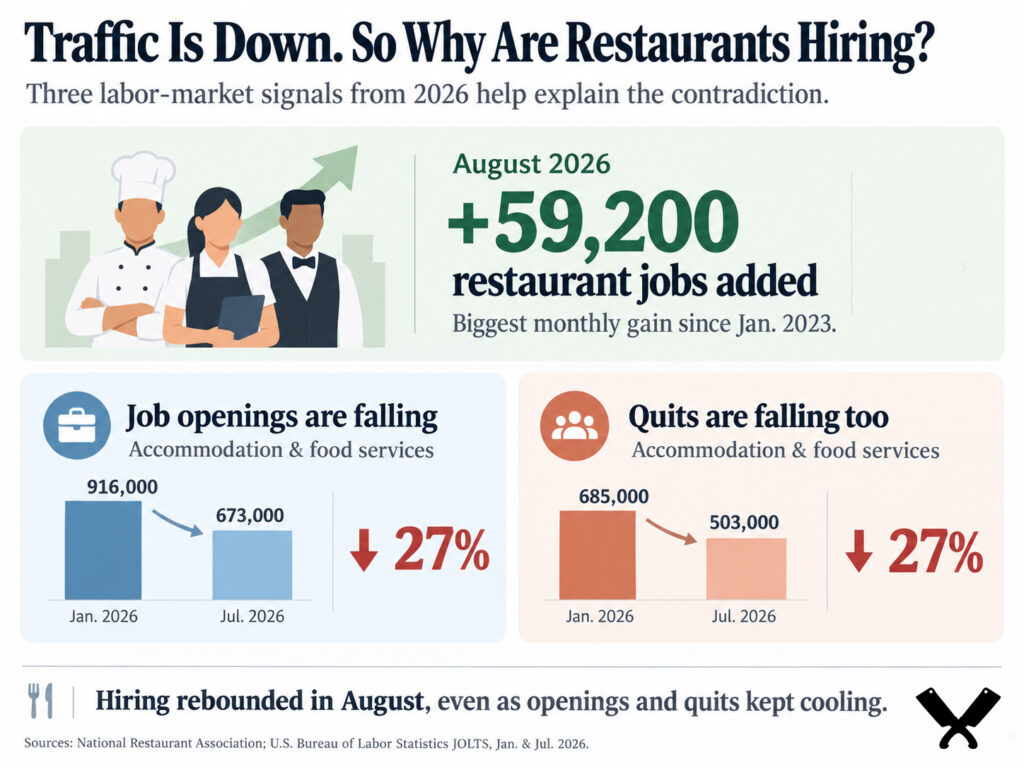
At the beginning of 2026, there were an estimated 916,000 job openings in accommodation and food services, the broader BLS category that includes restaurants. By July, that number had fallen to 673,000.
That’s a decline of roughly 27% in just six months.
Employee quits are moving in almost exactly the same direction.
An estimated 685,000 accommodation and food-service workers quit their jobs in January. By July, quits had fallen to 503,000 — another decline of about 27%.
Put those numbers together and August starts to look a little different.
Restaurants are adding employees, but there are fewer unfilled positions floating around the industry and fewer employees voluntarily walking out the door.
This doesn’t necessarily look like another version of the frantic post-pandemic labor shortage, when operators were competing for seemingly anyone willing to work a shift. Instead, the restaurant labor market may finally be showing signs of becoming a little more stable.
And restaurant operators appear to be planning around that stability.
Almost Nobody Plans to Cut Staff
Toast recently surveyed 676 restaurant operators and decision-makers about their plans for 2026.
Despite persistent concerns about inflation and customer traffic, 49% said they plan to increase the size of their staff. Another 48% expect to maintain their current staffing levels.
Just 3% plan to reduce staff.
There is an important caveat: fewer restaurants plan to grow their teams than last year. In Toast’s 2025 survey, 60% expected to increase staffing, compared with 49% this year.
So restaurants haven’t suddenly become wildly optimistic about hiring.
But in an environment where operators are still struggling with traffic, food costs and profitability, it’s striking that 97% expect to need at least as many employees as they have today.
That tells us something important about restaurant labor.
Hiring isn’t going away simply because business gets tougher.
Restaurants still need enough cooks, servers, bartenders, hosts, dishwashers and managers to operate. Employees leave. Weak hires need to be replaced. Schedules change. Hours expand and contract. Seasonal demand shifts.
And even restaurants serving fewer customers can find themselves needing new employees.
Hiring Is Actually Becoming a Bigger Concern
There’s another reason operators shouldn’t assume a cooler labor market means staffing is solved.
When Toast asked operators about their biggest challenges, 22% named hiring as one of their top three concerns, making it the second-most commonly cited challenge behind inflation.
More importantly, hiring concern was up six percentage points from last year – one of the largest increases of any challenge in the survey.
That’s an interesting combination.
There are fewer open jobs.
Fewer employees are quitting.
And yet operators are more concerned about hiring.
One explanation is that the staffing problem is changing.
When labor is extremely scarce, the challenge is simply finding people. When the market stabilizes, the challenge becomes finding the right people – employees who can actually do the job, fit the operation and hopefully stay long enough to justify the time spent recruiting and training them.
That makes retention increasingly important.
The Other Half of the Hiring Strategy: Keeping the People You Already Have
Toast asked operators what they would do if labor challenges increased over the next 12 months, with respondents able to select multiple strategies.
The most common answer, selected by 51%, was improving staff efficiency and speed of service. Right behind it, 49% said they would increase employee-retention efforts. Another 45% said they would optimize shift scheduling. By comparison, just 27% said they would purchase hiring software or use a recruiter.
That may be the most useful lesson in all of these numbers.
Restaurants clearly expect to keep hiring. But operators are also recognizing that continuously replacing employees is a difficult way to run a business.
Every employee you keep is one position you don’t have to recruit for again.
It’s one less job posting, interview process, onboarding cycle and training period. More importantly, experienced employees tend to know the menu, understand the systems, recognize regulars and know how the restaurant behaves when something goes wrong.
Retention isn’t simply an HR goal. The people who stay long enough become part of the restaurant’s identity.
A Cooler Labor Market Is an Opportunity
There is another encouraging side to falling quits and job openings.
Operators may have a little more breathing room than they’ve had in recent years.
When nearly every restaurant is desperate for employees and workers know another job is available down the street, hiring can become purely reactive: fill the shift, get someone trained and hope they stay.
A more stable labor market gives restaurants an opportunity to be more deliberate.
That might mean spending a little more time choosing the right candidate instead of the first available one. It might mean identifying the employees you absolutely don’t want to lose and asking what would make their jobs better. It might mean looking carefully at scheduling, management, training and opportunities for advancement before those employees start looking elsewhere.
And it doesn’t necessarily require creating an elaborate retention program.
Sometimes the useful question is simply:
Why do our best employees stay – and what causes good employees to leave?
If turnover is becoming less inevitable across the industry, restaurants have more reason to examine the turnover that still happens inside their own four walls.
You Still Need Good People
None of this makes running a restaurant any easier. Traffic may be soft, margins may be tight, and you may be thinking harder than ever about every new hire.
But one thing hasn’t changed: you still need good people to run the place.
The latest numbers suggest restaurants are continuing to hire, even as job openings and quits cool. That could give you something operators haven’t had much of in recent years: a little more room to be deliberate.
Instead of simply filling the next open shift, the opportunity may be to find the right people — and hold onto the employees who already know your menu, your systems, your regulars and the way your restaurant works.
Because the best employees don’t just fill positions. Over time, they become part of what makes your restaurant your restaurant.